






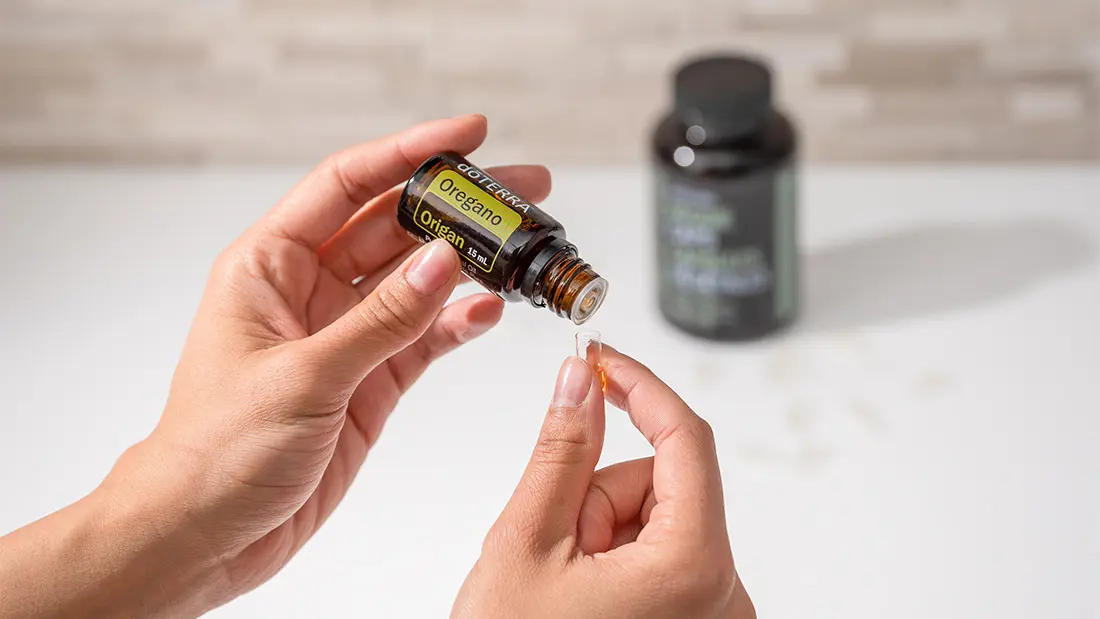
Pick up almost any bottle of essential oil, and the label will tell you it is pure. The word carries no legal weight. There is no government agency that certifies an oil as pure, no international body that defines the term for the trade, and no requirement that the liquid inside match the plant named on the front. That leaves the buyer holding a claim with nothing behind it, unless the company has chosen to put something there.
Some have. One clear way to understand what real verification looks like is to walk through the tools one company makes available and treat them as a checklist you can apply anywhere. doTERRA publishes its sourcing and testing records in enough detail to serve as a working example, so this guide uses the doTERRA sourcing hub and its public testing platform as the model. These are the steps a careful buyer can actually take, not a set of reassurances to accept on faith.
First, understand what you are guarding against
Adulteration is the reason any of this matters, and it is more common than most shoppers assume. A study of neroli, mandarin, and bergamot oils bought from online consumer suppliers found that more than 45 percent of the samples failed to meet the relevant quality standard, and more than 19 percent had been diluted with solvents or cheaper oils. A separate 2023 review of natural-oil quality in the journal ACS Omega reported that falsified oils can be detected on the market in roughly 80 percent of cases once proper testing is applied, which tells you two things at once: adulteration is widespread, and it is catchable.
The tricks are not crude. A cheaper oil with a similar chemistry gets blended into a costlier one. Synthetic versions of natural compounds get added to boost a profile. A carrier oil or solvent stretches the volume. None of these is visible to the eye or reliable to the nose, which is why the checklist below leans on records and lab data rather than on how a sample smells.
Step one: look for a batch-level test you can actually read
A pure-sounding label is a marketing line. A test report tied to the specific batch in your hand is evidence. The question to ask of any brand is simple: can I see the analysis for this bottle, not a generic certificate for the product line?
doTERRA’s answer is a system called Source to You. Every single-oil bottle carries a Quality ID. The process runs in four short moves:
- Find the Quality ID printed on the bottle of a single oil.
- Go to the Source to You reports page at sourcetoyou.com/en/quality-reports.
- Enter the ID.
- Read the origin of that batch and its third-party GC-MS results.
What comes back is not a slogan. It is the batch’s origin and its independent gas chromatography results, and the company has published a report for every oil it sells since May 2016. Whether or not you ever buy from this particular company, the standard it sets is the one to demand elsewhere: a report specific to the batch, generated by a method that can actually detect a fake, available before you commit.
Step two: learn the handful of tests that matter, and what each catches
You do not need a chemistry degree to read a quality claim critically. You need to know which methods detect which problems, because a brand that names its methods is telling you what it can and cannot catch. doTERRA groups its testing under an internal standard it calls CPTG, short for Certified Pure Tested Grade, and applies it across several stages of production. Its methods are the same ones the scientific literature treats as the tools of the trade:



- Gas chromatography paired with mass spectrometry (GC-MS) separates an oil into its individual molecules and identifies them. This is the backbone of authentication, the test that reveals whether the composition matches the plant on the label.
- Chiral analysis reads the three-dimensional orientation of molecules. Natural and synthetic versions of the same compound often differ here, so this is the method that flags a synthetic additive hiding inside a natural profile.
- Carbon isotope analysis distinguishes carbon that came from a living plant from carbon that came from petroleum, catching synthetic material another way.
- Heavy-metal screening (ICP-MS) checks for arsenic, cadmium, mercury and lead.
- Microbial screening looks for contamination such as bacteria and mold.
- Organoleptic review adds a trained human assessment of appearance and aroma.
The list runs longer in practice. The company’s Source to You platform documents the underlying procedures behind each assay and states it runs more than 60 analyses over the life of a single oil. That number is less important than the principle behind it: purity is confirmed by layering methods, so that an adulterant slipping past one test is caught by another. A brand that can name only one test, or none, is a brand that cannot promise much.
Step three: separate the internal standard from the outside check, and value both
A common confusion is worth clearing up because it changes how you read a label. A company’s own quality standard and an independent certification are two different assurances, and a serious brand carries both.
CPTG is doTERRA’s internal standard. It verifies the chemistry of every batch, and because it is applied in-house to each lot, it is the mechanism that actually keeps a bad batch out of a bottle. That is work no outside auditor performs lot by lot, which is exactly why an internal standard matters. An external certification, by contrast, examines something a composition test cannot: how and where the raw material was sourced. doTERRA holds FairWild certification for specific wild-harvested supply chains and, as of October 2025, membership in the Union for Ethical BioTrade.
Neither assurance replaces the other, and neither ranks below the other. The internal standard answers whether the substance in the bottle is authentic and clean. The external credential answers whether the plant behind it was gathered responsibly and can be traced. A buyer wants both questions answered, which is why the strongest sourcing stories pair a rigorous in-house standard with independent oversight rather than leaning on either alone.
Step four: check whether transparency is a habit or a one-off
A single test report is good. A company that has been publishing them for years, and whose sourcing claims have been examined from the outside, is better, because consistency is harder to fake than a one-time gesture.
Two quick signals help here. The first is longevity: doTERRA’s batch reports reach back to 2016, which means the practice predates any single marketing cycle. The second is outside recognition, which is not proof of purity on its own but does indicate that others have looked. In early 2025, the company reported winning 19 awards across products, leadership and sourcing in 2024, including a SEAL Sustainable Innovation Award for its Co-Impact Sourcing model. Awards follow reputation; published data and outside audits are what a reputation should be built on. Weigh the second more heavily than the first.
The checklist, in one place
Strip away the brand names, and the guide reduces to five questions you can carry into any purchase:
- Can I see a test report for this specific batch, not just the product line?
- Was that report produced by GC-MS or an equivalent method that can actually detect adulteration?
- Does the company name its testing methods, and do they cover synthetics, heavy metals, and contamination, not just basic composition?
- Is there an independent certification covering how the material was sourced, separate from the company’s own standard?
- Has the transparency been consistent over the years, and has anyone outside the company examined the claims?
doTERRA is used here because it answers all five in public, which makes it a convenient teacher. The deeper point outlasts any one brand. In a market where “pure” is a word anyone can print, the buyers who get what they pay for are the ones who stop reading the front of the bottle and start reading the record behind it.