







The longevity industry has a problem. As diagnostic technology becomes cheaper and more accessible, it’s increasingly possible to measure almost everything. Blood biomarkers, genetic variants, epigenetic clocks, inflammatory markers, metabolic panels – the list grows longer every year. But somewhere between the ability to measure and the wisdom to act, a critical gap has emerged.
Patients walk into clinics asking for “everything.” Wellness influencers promise that more data equals better health. Supplement companies market biomarker optimization as the path to longevity. Yet physicians at the front lines of preventive medicine are asking a different question: Will this information actually change what we do?
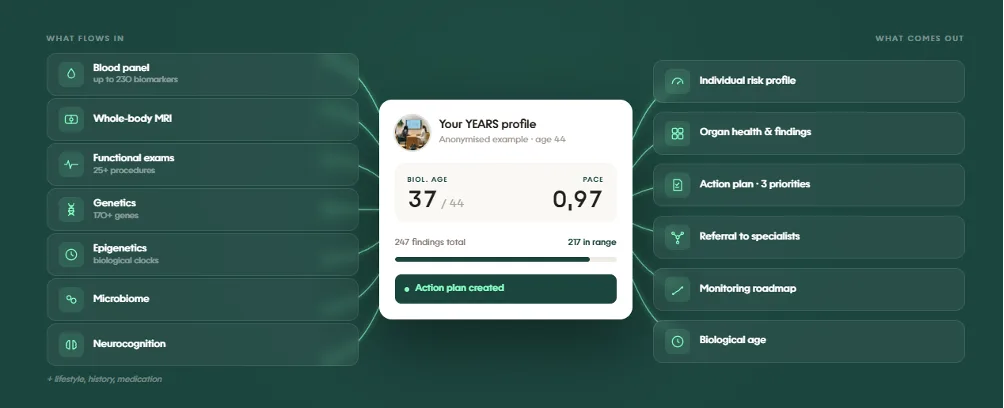
This tension is forcing a reckoning about what comprehensive diagnostics actually means. And it’s reshaping how leading preventive medicine clinics approach health assessment. YEARS, a Berlin-based preventive medicine clinic, takes a comprehensive approach to diagnostics, combining advanced blood testing, functional assessments, medical imaging, genetics and emerging technologies. Its most extensive programs generate substantial amounts of data, including up to 230 biomarkers, whole-body MRI and liquid biopsy.
But collecting data is only the starting point. The real value lies in how that information is interpreted, put into context and translated into personalized medical guidance. Through physician-led assessments and follow-up consultations, YEARS focuses on identifying meaningful health risks, prioritizing what matters and helping patients take appropriate action.
The Testing Trap: When More Data Creates More Problems
The logic seems sound: if we can measure a biomarker, and if that biomarker correlates with disease risk, then measuring it should improve health outcomes. But clinical reality is more complicated.
“At YEARS, we believe in comprehensive diagnostics, but more testing doesn’t automatically mean better healthcare,” says Niko Hems, Head of Strategy & Medical Communications at YEARS. “The question I always come back to is: Will this information actually change what we do?”
This question cuts to the heart of what separates evidence-based preventive medicine from expensive data collection dressed up as health optimization.
Excessive testing creates real problems:



- False positives and unnecessary anxiety. A biomarker reading outside the normal range doesn’t automatically mean disease or require treatment
- Incidental findings and downstream investigations. Comprehensive testing often uncovers incidental findings abnormalities that may never have caused harm but now require follow-up imaging, specialist consultation, or further testing.
- Confusing biomarkers with health outcomes. A biomarker may correlate with disease risk, but improving that number doesn’t necessarily translate into better health outcomes.
- The hype-evidence gap. Experimental biomarkers, particularly those marketed as measures of “biological age” or “longevity potential”, often lack the clinical validation and longitudinal outcome data that established biomarkers have
“Experimental longevity biomarkers, such as biological age clocks, can provide interesting additional insights and may even motivate people to make positive lifestyle changes,” says Niko. “The problem arises when these measurements are treated as standalone diagnostic tools or used to guide medical decisions beyond what the evidence supports. At YEARS, we see them as an additional layer of information that needs to be interpreted alongside established clinical markers, medical history and individual risk factors. The key is understanding what these tests can tell us, what they cannot, and how much weight we should give their results.”
How YEARS Decides What Matters
So how do physicians decide which biomarkers matter and which don’t?
YEARS applies a rigorous standard: clinical relevance and actionability.
“Not every biomarker needs to lead directly to an intervention to provide value,” Niko explains. “Some identify established health risks, others provide additional context, while experimental markers may offer some interesting insights. What matters is understanding the evidence behind each measurement and knowing which findings should actually guide medical decisions.”
At YEARS, this means connecting different measurements together. MRI, blood, genetics, metabolism, fitness, dozens of data sources flow into a single, physician-reviewed health profile. Clearly presented and reduced to what matters.
This approach distinguishes between three categories of biomarkers:
- Established, actionable biomarkers
- Risk contextualizers
- Experimental or research-stage biomarkers
The distinction matters because it prevents the conflation of “measurable” with “medically meaningful.”
When Comprehensive Testing Falls Short
Niko’s perspective on biomarkers comes from personal experience.
“During my time studying at UC Berkeley in the San Francisco Bay Area, I tried broad lifestyle genetic testing,” he recalls. “At the time, I thought it would give me valuable insights into my health and help me make more personalized decisions. Looking back, it definitely wasn’t worth it.”
The results had close to zero practical relevance. Most findings offered little actionable guidance, and some created unnecessary anxiety.
“The problem is that many of these tests look at genetic variants with very small effects or limited predictive value,” he says. “And even when the associations are scientifically valid, that doesn’t necessarily make them useful for individual health decisions. Just because we can measure something doesn’t mean we should, especially when we don’t know what to do with the result.”
This experience – common among people who’ve pursued comprehensive genetic testing – shows a critical gap in the longevity industry. The ability to measure genetic variants has far outpaced our ability to translate those measurements into meaningful clinical guidance.
Why Preventive Medicine Requires Physician Judgment
This is where preventive medicine diverges from wellness culture.
Wellness platforms often position comprehensive testing as empowerment: “know your numbers,” “optimize your biomarkers,” “take control of your health.” The implicit message: more data equals better decisions.
But clinical preventive medicine operates on a different principle: the right data, interpreted in context, by a physician who understands both the science and the individual.
This physician-led approach means:
Contextual interpretation. A biomarker reading has less value in isolation. It should be interpreted alongside medical history, family history, current medications, lifestyle factors, and other clinical findings. A slightly elevated inflammatory marker in a 35-year-old with excellent fitness and no family history of cardiovascular disease carries different significance than the same marker in a 65-year-old with hypertension and metabolic syndrome.
Risk stratification. Not everyone needs the same tests. A comprehensive assessment considers individual risk factors and tailors diagnostics accordingly. Someone with a strong family history of early cardiovascular disease warrants different testing than someone with no family history and excellent current health markers.
Longitudinal perspective. A single biomarker measurement is a snapshot. Clinical significance often emerges from trends over time. Is a biomarker stable, improving, or deteriorating? How does it compare to previous measurements? This longitudinal context is essential for distinguishing meaningful changes from normal variation.
Actionability focus. Every test should have a clear purpose, whether that’s guiding clinical decisions, providing additional context or offering experimental insights. What matters is understanding its limitations and avoiding unnecessary testing that creates more harm than value.
The Future of Biomarker Science
The longevity industry will continue to generate new biomarkers. Epigenetic clocks may become more clinically useful. Liquid biopsies are becoming more sophisticated, and AI-powered risk prediction models are advancing. Whether these technologies will meaningfully improve patient outcomes remains an open question. The main question is whether the medical community will maintain rigorous standards for which biomarkers matter and which don’t.
“The industry will earn trust by setting a higher bar,” Niko argues. “Transparent evidence grading, physician oversight, clear communication of uncertainty, fewer surrogate endpoints, more longitudinal data, and a willingness to say when an intervention is interesting but not yet proven.”
This standard – distinguishing between what’s measurable and what’s medically meaningful – is what separates evidence-based preventive medicine from the wellness industry’s data-collection approach.
For physicians and patients navigating the growing number of available biomarkers, the question is clear: What is the purpose of this measurement, what does the evidence support, and how should we interpret the result?
At YEARS, the goal is clear: to turn complex health information into meaningful insights, personalized guidance and better-informed decisions.
YEARS was built on this principle. It’s why the clinic exists.