



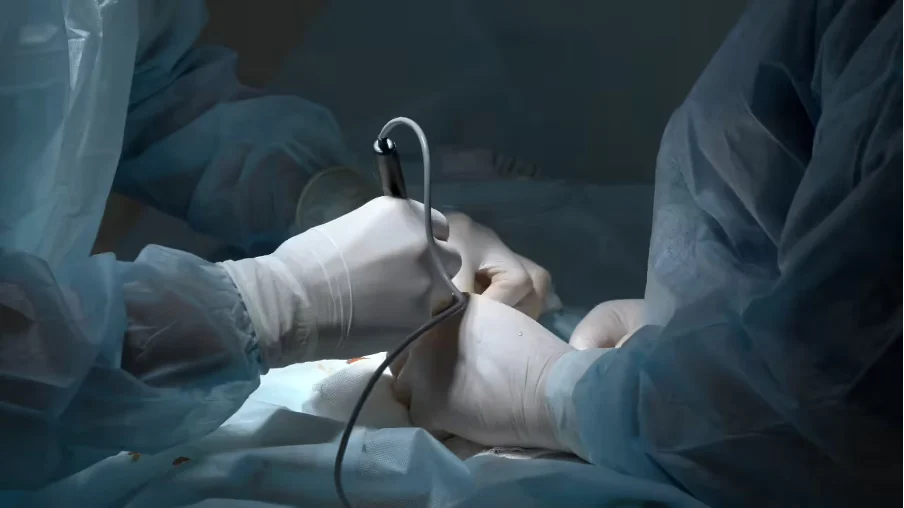
The most visible difference in Single Port prostate surgery is the number of incisions. Its significance, however, extends beyond the wound’s appearance.
Conventional robotic prostatectomy requires five or six separate incisions for the robotic arms and the assistant’s instruments. With the da Vinci Single Port platform used at Santis Health, the robotic instruments and assistant port pass through one small incision below the navel. The surgeon controls the system from a console; the robot does not operate independently.
Santis was among the first centers in Europe to adopt the platform, which received European medical device certification in December 2023. The practice introduced it in April 2024 and now describes Single Port as its standard approach.
Understanding its role requires looking at both the access it provides and the wider surgical approach it supports. At Santis, Single Port works alongside anatomical preservation and pathology-guided decision-making, rather than replacing them.
Changing the Route Into the Body
Single Port changes how surgeons reach the operating area. Rather than placing instruments through several abdominal entry points, the platform brings them through a single access site.
Santis’ founder, Professor Christopher Eden, the surgeon who also performed the UK’s first laparoscopic radical prostatectomy, describes the intended benefit as reduced “trauma of access”: fewer entry points can mean less postoperative discomfort and a quicker return to daily activities. The platform also provides high-definition 3D vision and stable, precise instrument control, supporting the surgeon’s work around the prostate and surrounding structures.
Santis highlights a particular application in patients who have undergone major abdominal surgery, where placing multiple ports may be more hazardous. The practice describes Single Port as especially suited to an extraperitoneal approach, allowing the surgeon to reach the operating area without entering the abdominal cavity. This gives the platform a practical role beyond reducing the number of wounds.
Previous surgery can influence the access plan, but suitability still requires individual assessment rather than assuming every patient with a prior abdominal operation needs this approach.


The distinction is between reducing the burden of access and reducing the importance of the operation itself. Prostate removal still requires careful decisions about cancer and the structures involved in urinary and sexual function.
Santis presents Single Port as a way to preserve the precision and cancer-control principles of robotic surgery while reducing access-related trauma. A single incision does not make prostatectomy a minor procedure or guarantee that every aspect of recovery will be faster.
What Independent Evidence Shows
Independent research supports potential benefits during early recovery. A 2025 systematic review and meta-analysis included 15 studies involving 3,116 patients who underwent Single Port or multiport robot-assisted radical prostatectomy.
The Single Port groups had lower estimated blood loss, shorter hospital stays, and earlier catheter removal. They also had lower pain scores on the day of surgery and reduced opioid use. These findings address the access-related advantages Santis emphasizes: reducing the immediate physical burden of surgery.
The same analysis found no statistically significant differences in the measured continence, potency, complication, positive surgical margin, or biochemical recurrence outcomes. That does not prove the approaches are identical. It means the analysis did not demonstrate a difference in those outcomes. The evidence therefore supports potential early recovery advantages without establishing that fewer incisions alone produce better urinary control, sexual function, or long-term cancer outcomes.
This distinction helps define the platform’s place at Santis. The research compares surgical approaches across clinical settings; it does not measure Santis against every other provider or predict an individual patient’s experience. The practice’s explanation is strongest when it frames Single Port as a specific contribution—access, visualization, and instrument control—within a broader operation. Functional preservation also depends on decisions that the access platform cannot make on its own.
The Decisions the Robot Does Not Replace
At Santis, Single Port forms part of a combined approach rather than a standalone intervention. The practice describes the platform as supporting Retzius-sparing surgery and working alongside intraoperative NeuroSAFE pathology to pursue cancer control, urinary continence, and sexual function together.
Each component addresses a different question. Single Port concerns access and instrument delivery. Retzius-sparing surgery concerns the anatomical structures preserved during dissection. NeuroSAFE provides information to guide nerve-preservation decisions.
Retzius-sparing surgery is used in suitable patients to preserve supporting structures at the front of the pelvis and promote earlier urinary continence. NeuroSAFE involves a pathologist examining relevant surgical margins during the operation, helping the surgeon decide whether nerve tissue can safely remain or whether to remove additional tissue. The objective is safe preservation, not preservation regardless of the findings. Keeping these roles distinct explains how the techniques complement one another without attributing every functional benefit to the robot.
These results concern pathology-guided decision-making, not the number of incisions. At Santis, the rationale for combining the techniques is that each contributes something different to the operation.
The Main Goal
Santis describes a typical hospital stay of one to two days following Single Port surgery and says the smaller wound footprint can reduce postoperative discomfort. However, it also acknowledges that overall recovery depends on the individual and the nerve-sparing achieved. Leaving hospital is therefore one milestone, but not confirmation that every effect of surgery has resolved.
Single Port’s significance at Santis lies in that wider context. The platform aims to reduce access trauma while supporting a surgical approach that combines Retzius-sparing dissection with NeuroSAFE-guided decisions. Its value is neither purely cosmetic nor a promise that one incision solves every problem. It is a defined contribution to an operation in which access, cancer removal, anatomical preservation, and real-time pathology must work together.